Universe · 13.8 billion years
The Evolution of the Universe
Move through 13.8 billion years of cosmic history. Drag the timeline, choose a milestone, or press Play to watch matter cool, form stars and galaxies, and leave the microwave background we still observe today.
Dark-energy era
Dark energy keeps stretching space, and the cosmic web keeps drifting apart.
Non-linear time · real-time GPU simulation · illustrative physics
This experience needs WebGL. Try a current version of Chrome, Firefox, Edge or Safari, or enable hardware acceleration.
How to read the map
The stage settles into a logarithmic slice of the observable universe: the Sun at the centre, the Milky Way and its neighbours in the middle, and the Big Bang's afterglow at the rim. Every marker on the map is now a live callout with its key facts and links. Follow any of them to go deeper.
The Big Bang in five steps
The Big Bang is not an explosion into empty space. It is the expansion of space itself from a hot, dense state about 13.8 billion years ago. The whole story, briefly:
-
The beginning
All of space, time, matter and energy begin in an unimaginably hot, dense state. Our current physics cannot yet describe the very first instant: the Planck era.
-
Inflation
In a fraction of a second, space expands by an enormous factor, stretching itself flat and smooth, and stamping in the tiny ripples that later grow into galaxies.
-
First particles and nuclei
Within minutes, quarks bind into protons and neutrons, which fuse into hydrogen, helium and a trace of lithium, the lightest elements.
-
First light
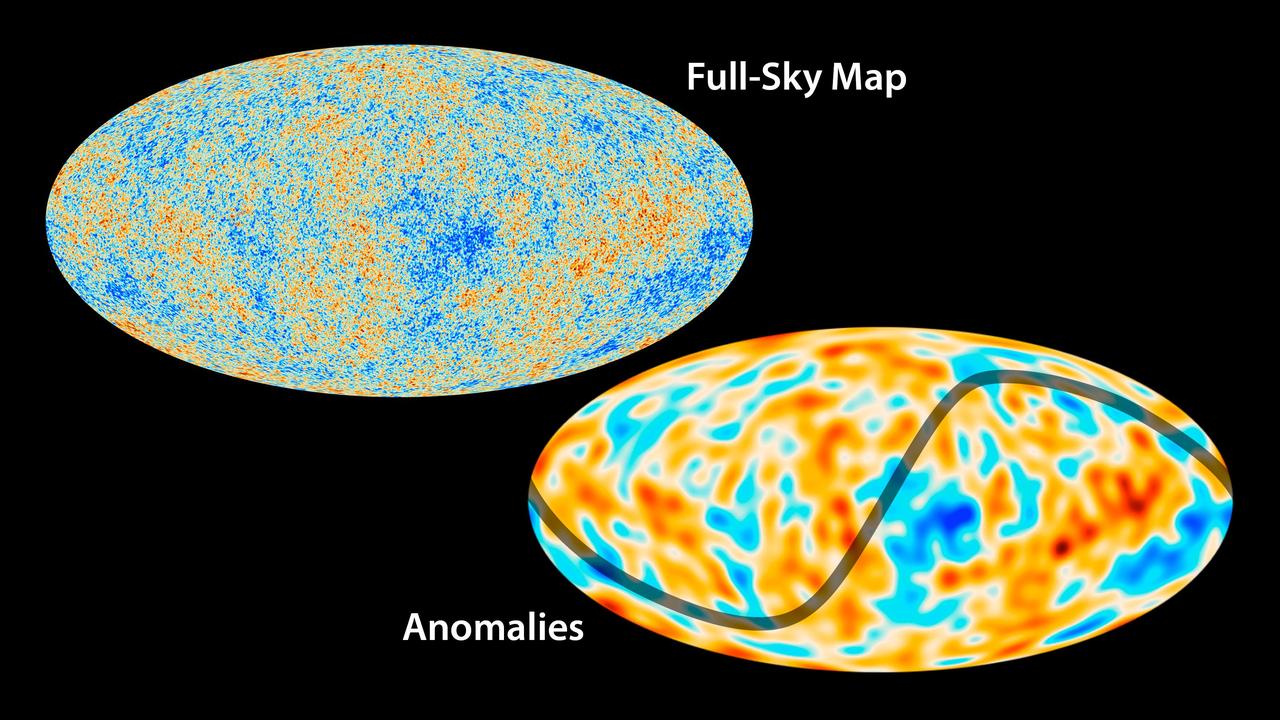
After about 380,000 years, electrons latch onto nuclei, the fog clears, and light streams free. Stretched by expansion, that light is today's cosmic microwave background.
-
Stars, galaxies and us
Over hundreds of millions of years, gravity gathers matter into the first stars and galaxies. The Solar System forms about 9.2 billion years later, and life follows on Earth.
Read the full chronology: Chronology of the universe · Big Bang.
The universe's expected lifetime
We are 13.8 billion years into a story whose ending lies far in the future. These are the eras cosmology expects ahead (approximate, illustrative, and still being refined):
- Now → ~10¹⁴ yearsStelliferous era: stars keep forming until the raw gas runs out, then the last stars fade.
- ~10¹⁴-10⁴⁰ yearsDegenerate era: the cosmos is left to white dwarfs, neutron stars and black holes; matter may slowly dissolve if protons decay.
- ~10⁴⁰-10¹⁰⁰ yearsBlack-hole era: black holes dominate, then evaporate away through Hawking radiation.
- Beyond ~10¹⁰⁰ yearsDark era, or heat death: the universe approaches a near-uniform, cold, dark state of maximum entropy.
If dark energy strengthens, a Big Rip could tear everything apart first; if expansion ever reversed, a Big Crunch would follow. Neither is favoured by current data. Learn more about the ultimate fate and the heat death of the universe.
Photos
Real light, captured by telescopes. Each image links to its source.



Simulations and interactives
Watch the universe evolve in real time, from full cosmological simulations to NASA's own orbiters and telescopes.
Frontiers, theories and ideas on the edge
Cosmology is a live subject. These are the open questions, competing models and speculative ideas, each with its own page.
Further reading: Hubble's law · dark energy · James Webb Space Telescope · gravitational-wave background.
Articles and further reading
- NASA Universe: news and explainers from NASA's astrophysics division.
- ESA Planck: the mission that mapped the cosmic microwave background in detail.
- Observable universe: what we can see, and why there's more beyond the horizon.
- Expansion of the universe: how space itself is stretching.
- Cosmic microwave background: the afterglow of the Big Bang.
Top recent videos
A short watchlist of recent explainers and documentaries on the universe.
-
Decoding the Universe: Cosmos | Full Documentary | NOVA | PBS NOVA PBS Official
-
Five Wonders of our Universe | Universe | BBC Earth Science BBC Earth Science
-
Everything You Need to Know About Gravitational Waves in 2026 Fraser Cain
Videos are embedded from YouTube and load only when you open a card.