Directory · Black Holes
Black Holes
Compare black holes from nearby stellar remnants to the ultramassive objects in distant quasars. Select two or more entries to review their scale, distance, host and supporting evidence.
Known black holes
Icon diameter follows event-horizon size on a logarithmic scale.
Anatomy in motion
A black hole in motion
This NASA simulation shows a black hole’s shadow, its turbulent accretion disk, and the lensed images that gravity creates around it. Hover a label to preview its annotation, then click to keep it open.
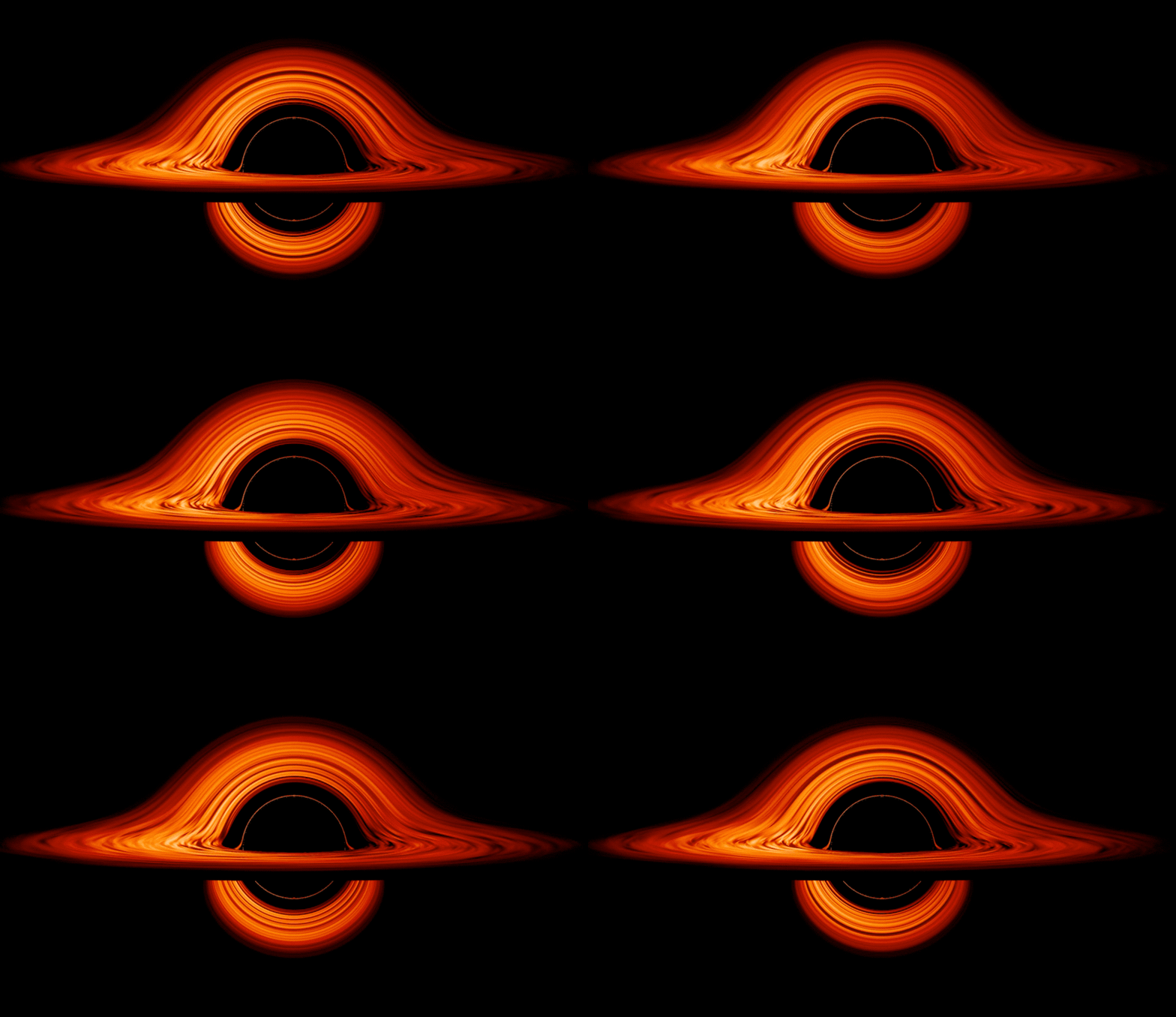
Hover or tap a numbered marker, or choose a feature below. Click to pin the annotation; Esc clears it.
True-scale explorer
Feel the scale
One continuous, true-size view. Zoom from a city-sized horizon to an ultramassive black hole: every circle stays in true proportion to the others at the current scale.
Full size range
logarithmic overview
StellarSupermassiveUltramassive
Compare black holes
Select two or more entries above. The comparison updates automatically.
Choose at least two black holes to compare type, mass, distance, host, discovery and defining evidence.
Scale and uncertainty
How to read these numbers
Masses and distances are rounded published estimates and can change with new observations, especially for distant quasars and dormant stellar remnants. “M☉” means solar masses. Distances for far quasars are light-travel distances and are not directly comparable to nearby star distances.