Ultramassive black holeQuasar
TON 618
A quasar powered by one of the most massive black holes known, shining across more than ten billion years of cosmic time.
- Type
- Ultramassive black hole / quasar
- Mass
- About 40-66 billion M☉
- Distance
- About 10.4 billion light-years
- Host
- Quasar host galaxy
- Identified
- 1957 catalogue; quasar in the 1960s
- Key trait
- Extremely luminous accreting black hole
The quasar in survey data
SDSS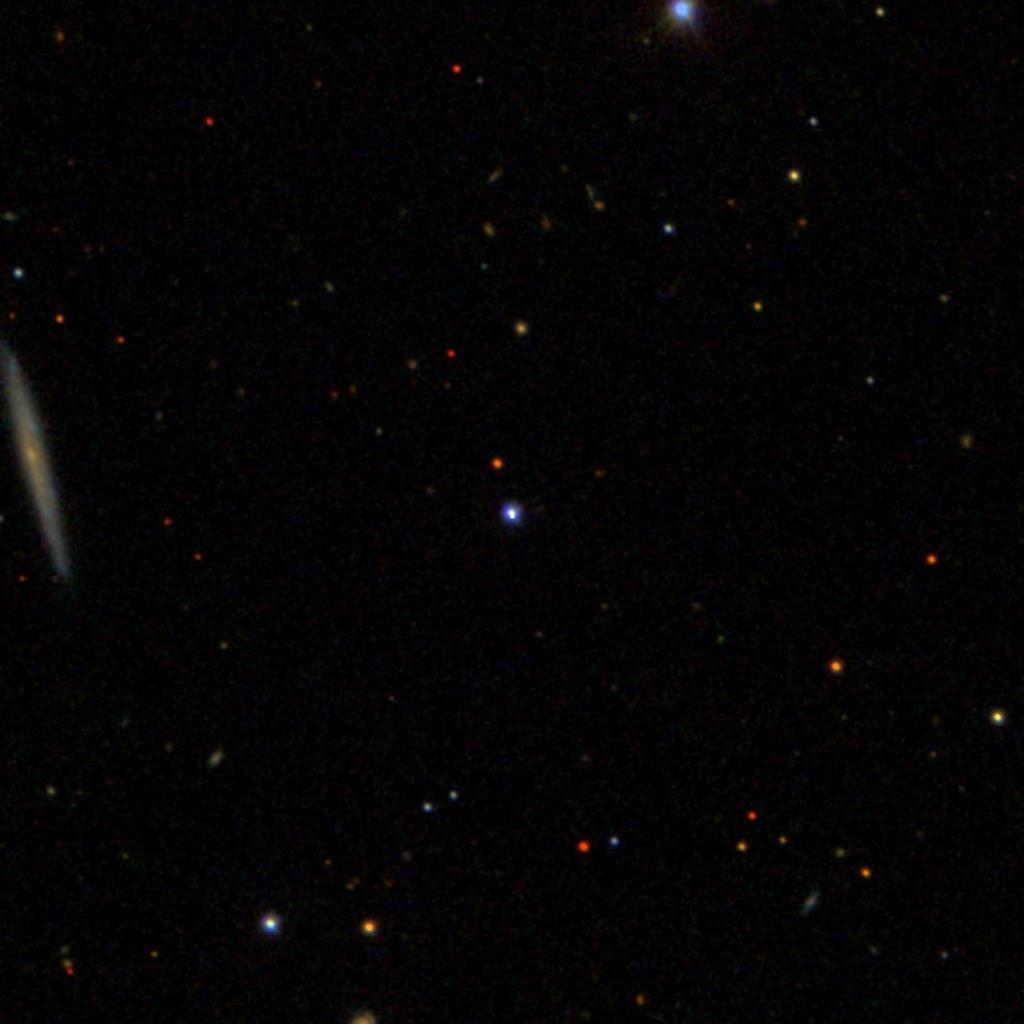
A quasar at cosmic noon
TON 618 is a quasar: an extremely luminous active galactic nucleus powered by gas falling onto a supermassive black hole. Its light has travelled for about 10.4 billion years, so we see it as it was when the universe was much younger.
Its enormous luminosity comes from the accretion disc around the black hole, where matter is heated to millions of kelvin before disappearing across the event horizon.
How its mass is measured
Astronomers cannot weigh a distant black hole directly. Instead, they measure the speed and radius of gas orbiting it, using the broad emission lines in the quasar's spectrum and the time it takes the inner disc to respond to changes in radiation.
These methods give a mass of tens of billions of Suns, though the exact value remains uncertain. The commonly quoted figure is around 66 billion solar masses; some analyses give a lower mass.
Why it is extreme
A black hole this massive must have grown enormously since the early universe. Explaining how it assembled so quickly is one of the open problems in black-hole astrophysics, and TON 618 is a key benchmark for models of quasar growth.
Worth knowing
TON 618 is one of the most massive black holes known.
Its light set out when the Universe was far younger.
It outshines its entire host galaxy as a quasar.
Recommended pop-science media
-
TON 618: The Black Hole That Breaks the Universe NullSpace
-
Why TON 618 Is So Terrifying Ridddle
Videos are embedded from YouTube and load only when you open a card.