GalaxySatellite of the Milky Way
The Large Magellanic Cloud
The Milky Way's brightest satellite: an irregular cloud of gas and young stars that holds the most active stellar nursery in the Local Group.
- Type
- Dwarf irregular / Magellanic spiral
- Distance
- About 163,000 light-years · 50 kpc
- Diameter
- About 14,000 light-years
- Stars
- Tens of billions
- Role
- Largest satellite of the Milky Way
- Notable
- Tarantula Nebula · Supernova 1987A
A cloud in the southern sky
NASA/JSC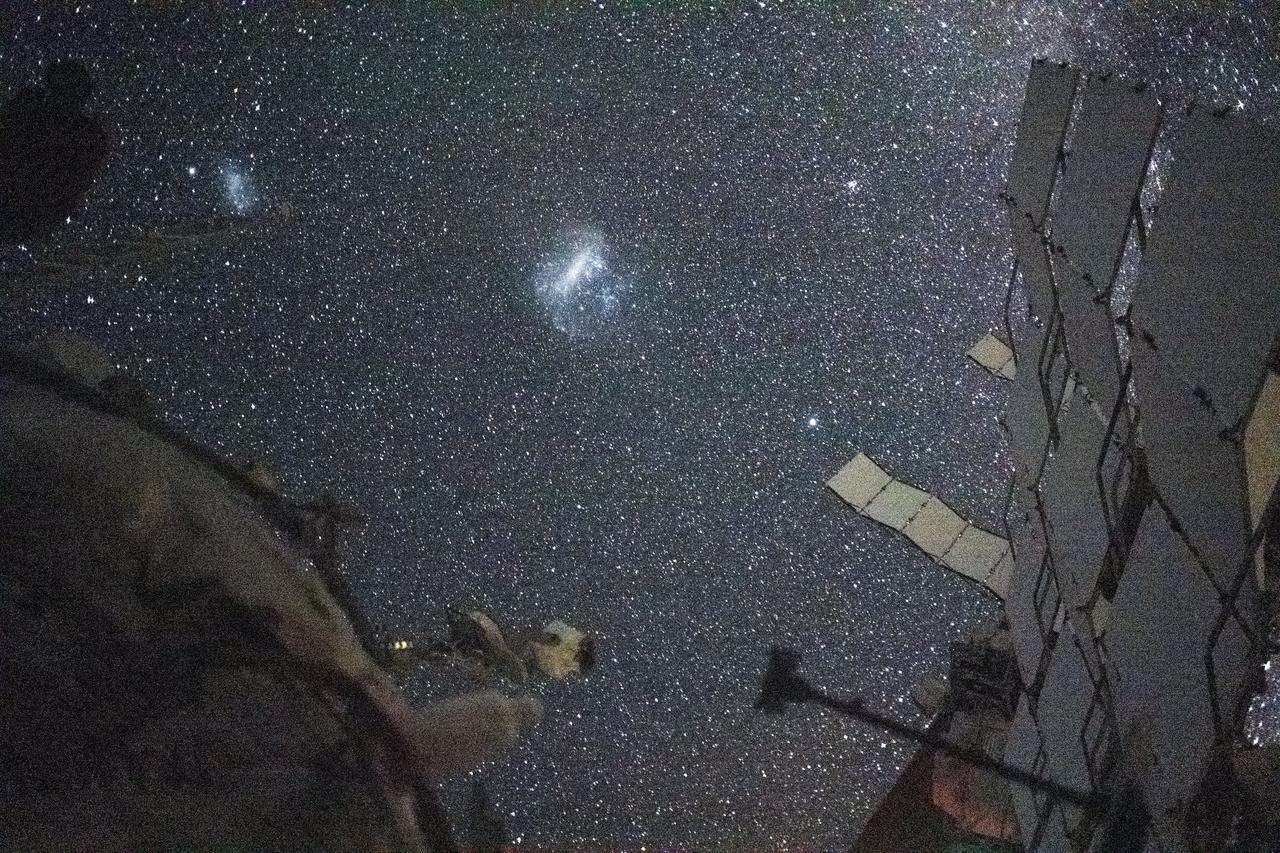
Explore the cloud
Scroll or pinch to zoom and drag to pan. Select a marker to read about the bar, the Tarantula Nebula, or the massive stars of R136.
An illustrative model · scroll or pinch to zoom, drag to pan · sizes and distances are not to scale
A cloud in the southern sky
The Large Magellanic Cloud is visible to the unaided eye as a faint, glowing patch in the southern constellation Dorado. It is a dwarf galaxy orbiting the Milky Way, and the nearest galaxy of substantial size after the small satellites that circle us directly.
Its shape is messy: a short central bar, one patchy spiral arm, and clouds of gas and dust pushed around by its long interaction with the Milky Way. Astronomers sometimes describe it as a Magellanic spiral, a barred dwarf with a single arm.
The Tarantula Nebula
At the heart of the LMC lies the Tarantula Nebula, also called 30 Doradus, the most active star-forming region in the entire Local Group. It is so bright that, if it sat at the distance of the Orion Nebula, it would cast visible shadows on Earth.
The nebula's core is the star cluster R136, packed with young, massive stars. Their intense ultraviolet light and fierce winds sculpt the surrounding gas into the spidery filaments that give the nebula its name.
Stars and supernovae
R136 hosts R136a1, one of the most massive stars known, with an estimated mass of well over a hundred Suns. Such stars live fast and die as supernovae, seeding the cloud with heavy elements.
In 1987, a supernova appeared in the LMC, the nearest seen in centuries. Supernova 1987A has become the best-studied stellar explosion in history, and its expanding debris is still watched today. No planets have been confirmed in the LMC; its worlds remain beyond our reach for now.
Neighbours and tides
The Large Magellanic Cloud is paired with the Small Magellanic Cloud, a smaller companion. The two are connected by a bridge of gas, and a long stream of material trails them both around the Milky Way, evidence of tidal forces stretching and reshaping them.
The LMC is gradually losing its gas to these encounters, a reminder that even galaxies are shaped by their neighbours.
Worth knowing
The LMC is the Milky Way's largest satellite galaxy.
The Tarantula Nebula is the Local Group's most active stellar nursery.
Supernova 1987A was the nearest supernova in centuries.
Further reading
- NASA Hubble mission: Tarantula Nebula and SN 1987A imagery.
- ESA/Hubble image archive: views of the LMC and its clusters.
- NASA Image and Video Library: more views of the Large Magellanic Cloud.