GalaxyLocal Group
The Triangulum Galaxy
The third-largest galaxy in our Local Group: a face-on spiral of loosely wound arms, visible to the unaided eye only under the darkest skies.
- Type
- Spiral galaxy (SA(s)cd)
- Distance
- About 2.73 million light-years
- Diameter
- About 60,000 light-years
- Stars
- About 40 billion
- Designations
- M33 · NGC 598
- Group
- Third-largest member of the Local Group
A neighbour seen face-on
NASA/JPL-Caltech/Univ. of Ariz.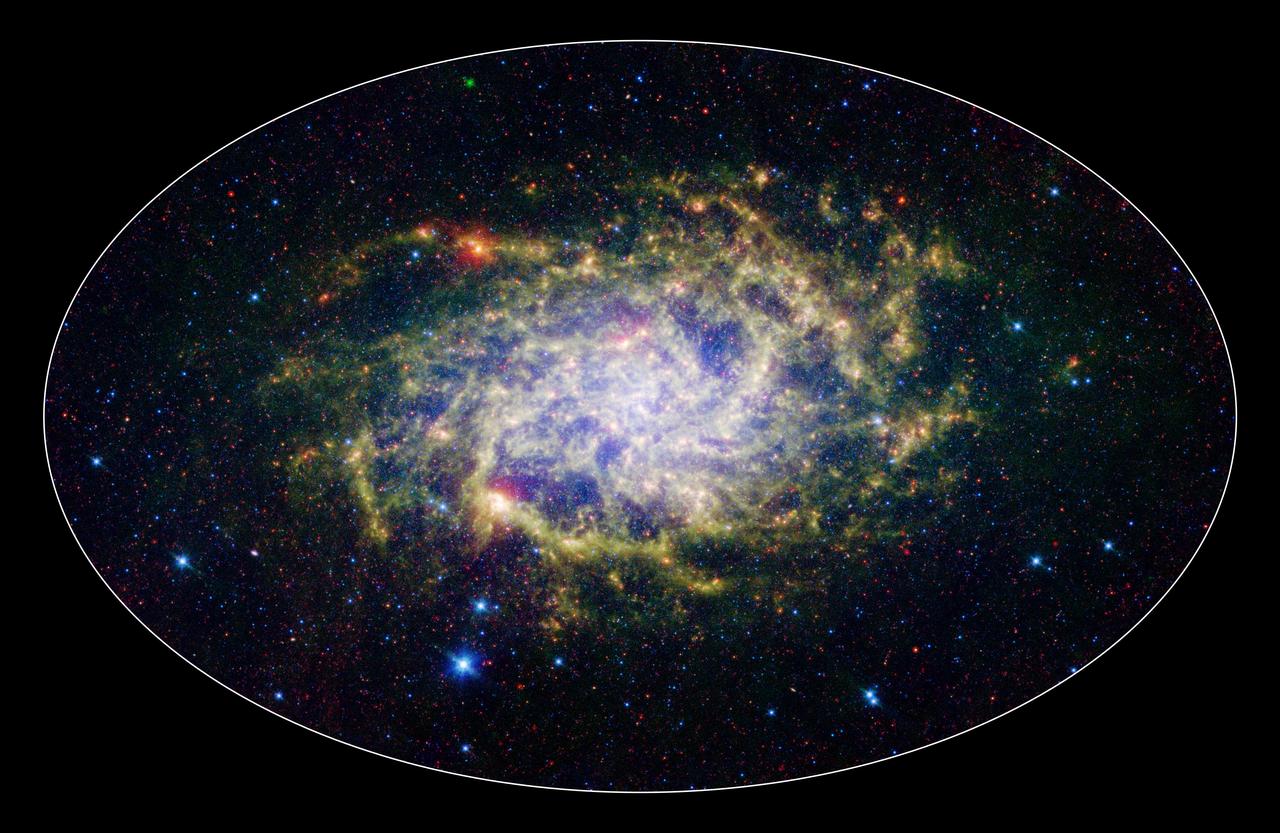
Explore the galaxy
Scroll or pinch to zoom and drag to pan. Select a marker to read about the nucleus, the spiral arms, or the giant star-forming region NGC 604.
An illustrative model · scroll or pinch to zoom, drag to pan · sizes and distances are not to scale
A face-on spiral next door
The Triangulum Galaxy is the third-largest galaxy in the Local Group, after the Andromeda Galaxy and our own Milky Way. Because we see it nearly face-on, its spiral arms are spread out across the sky like a pinwheel, making it a favourite target for studying how spiral structure forms.
Its arms are looser and patchier than those of grand-design spirals such as the Whirlpool. They are traced by clusters of hot, young blue stars and glowing clouds of hydrogen, set in a disc of older stars.
A modest nucleus
Unlike the Milky Way and Andromeda, the Triangulum Galaxy does not appear to hide a giant black hole at its centre. Its nucleus is a compact concentration of stars, and searches have found no evidence for a supermassive black hole weighing millions of Suns.
That makes Triangulum an interesting contrast: it is a fully grown spiral galaxy whose core apparently grew without a massive central engine.
Stars and star formation
The galaxy's most famous feature is NGC 604, one of the largest star-forming regions in the Local Group. Hundreds of hot, massive young stars have already lit up inside it, and their winds and radiation carve cavities in the surrounding gas.
Hubble can resolve individual stars across much of the galaxy, but its planets are far beyond our instruments. No exoplanet has been confirmed in the Triangulum Galaxy; for now its worlds remain a question rather than an observation.
In the Local Group
Triangulum is gravitationally associated with the Andromeda Galaxy and may have brushed past it in the distant past, an encounter that could explain streams of stars around Andromeda's disc. Together the Milky Way, Andromeda, and Triangulum dominate our small corner of the cosmos.
In a few billion years the Milky Way and Andromeda are expected to merge; Triangulum's own fate is less certain, and it may be pulled into that combined galaxy later, or continue on a long orbit around it.
Worth knowing
Triangulum is the third-largest galaxy in our Local Group.
It may have no supermassive black hole at its centre.
NGC 604 is one of the largest star-forming regions in the Local Group.
Further reading
- NASA Hubble mission: images of the Triangulum Galaxy.
- ESA/Hubble image archive: a resolved view of M33's stars.
- NASA Image and Video Library: more views of the Triangulum Galaxy.