X-ray binaryWhirlpool Galaxy
M51-ULS-1
An ultraluminous X-ray source in the Whirlpool Galaxy: a compact object feeding on a massive companion star, orbited by the first planet candidate found beyond the Milky Way.
- Object type
- Ultraluminous X-ray binary
- Host galaxy
- The Whirlpool (M51) · ~28 million light-years
- Compact object
- Neutron star or black hole
- Companion
- A young, massive star
- Luminosity
- Far above a stellar black hole's Eddington limit
- Planet candidate
- M51-ULS-1b, detected by X-ray transit
A bright X-ray source
NASA/JPL-Caltech/IPAC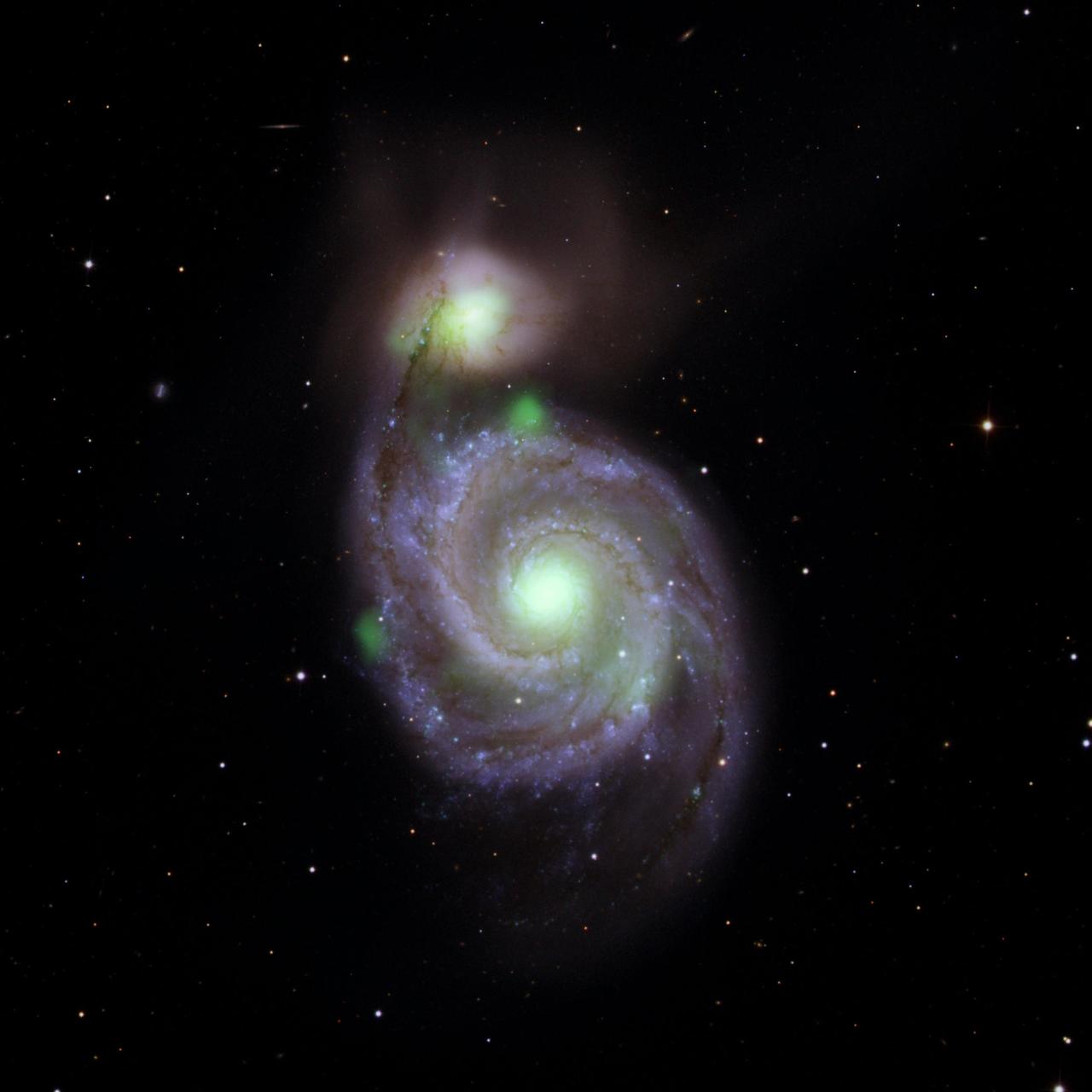
A bright X-ray source in M51
M51-ULS-1 is one of the brightest X-ray sources in the Whirlpool Galaxy. It is an ultraluminous X-ray source, or ULX: an object that shines far more brightly in X-rays than a stellar-mass black hole is expected to be able to without blowing itself apart.
That extreme brightness is what made it possible to notice something extraordinary: a brief, complete dip in its X-ray light that looked like a planet passing in front of it.
A compact object feeding on a companion
M51-ULS-1 is a binary system. A compact remnant, either a neutron star or a black hole, pulls gas from a massive companion star. The falling gas heats up to millions of degrees and radiates the X-rays we detect.
The system is young and massive, typical of the bright X-ray sources found in regions of recent star formation. Its exact nature, neutron star or black hole, is not yet settled.
The planet candidate
In 2020, a team led by Rosanne Di Stefano announced that a transit-like dip in M51-ULS-1's X-ray light could be explained by a planet roughly the size of Saturn, M51-ULS-1b, crossing in front of the X-ray source.
If confirmed, it would be the first planet found in another galaxy. Because a second transit may not occur for decades, confirmation will require patience and careful monitoring.
How we study it
X-ray observatories such as NASA's Chandra and NuSTAR, and ESA's XMM-Newton, track the source's brightness over years. A transit reveals itself as a short, symmetric dimming, distinct from the flickering that X-ray binaries do on their own.
The technique offers a way to search for planets that ordinary transit and radial-velocity methods cannot reach: worlds orbiting X-ray binaries in other galaxies.
Recent publications
| Year | Paper | Venue | Link |
|---|---|---|---|
| 2021 | A possible planet candidate in an external galaxy detected through X-ray transit | Nature Astronomy | DOI |
The discovery paper is also available open-access at arXiv:2009.08987.
Worth knowing
M51-ULS-1 is an ultraluminous X-ray source in the Whirlpool Galaxy.
Its compact object is either a neutron star or a black hole.
It may host the first planet ever found outside the Milky Way.