GalaxyCanes Venatici
The Whirlpool Galaxy
A grand-design spiral caught mid-encounter with a smaller companion, its two bright arms making it one of the most photographed galaxies in the sky.
- Type
- Grand-design spiral (SA(s)bc)
- Distance
- About 28 million light-years · 8.6 Mpc
- Diameter
- About 76,000 light-years
- Companion
- NGC 5195, a smaller interacting galaxy
- Designations
- M51 · NGC 5194
- Planet candidate
- M51-ULS-1b, the first found in another galaxy
A grand design in profile
NASA/CXC · NASA/ESA · STScI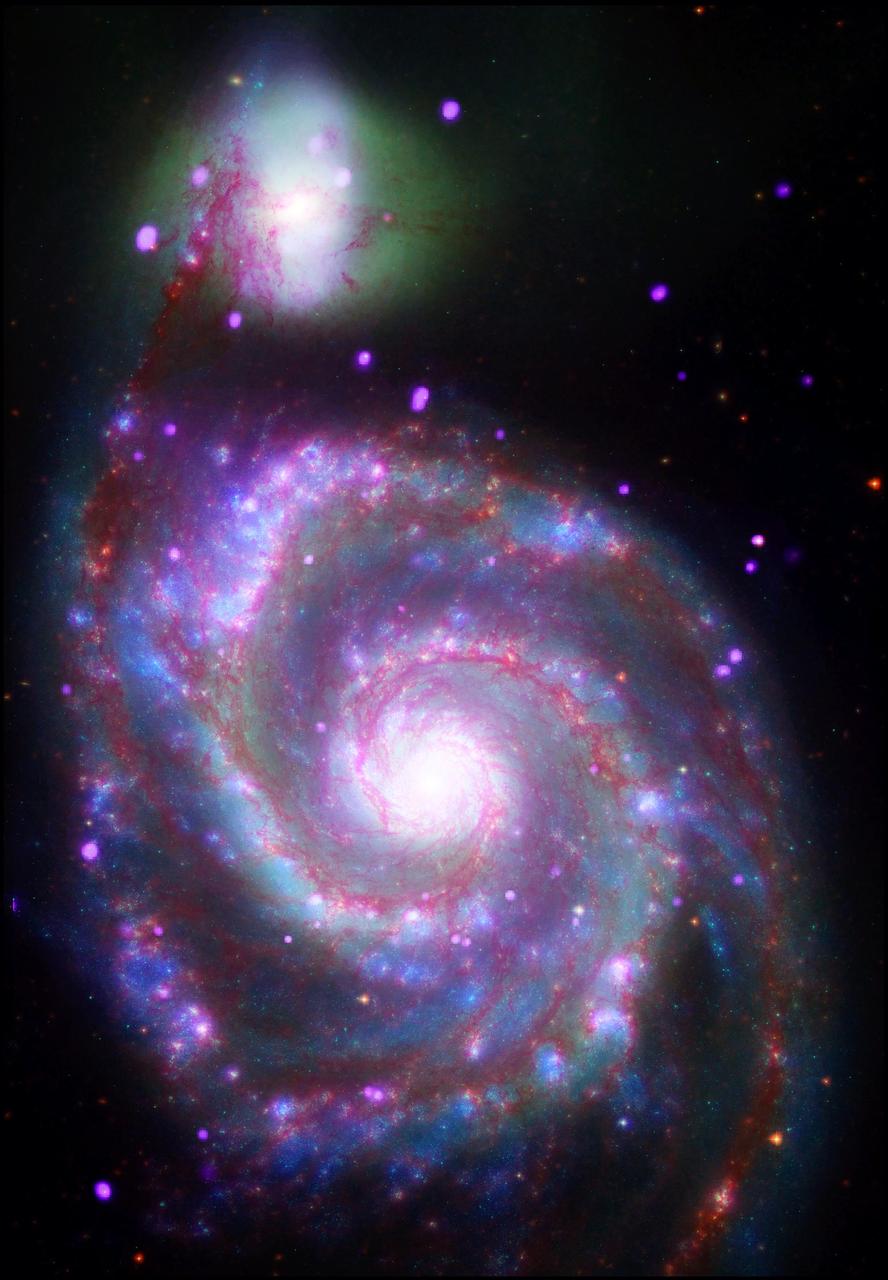
Explore the galaxy
Scroll or pinch to zoom and drag to pan. Select M51-ULS-1 to drop from the galaxy to its star system, then to its candidate planet.
An illustrative model · scroll or pinch to zoom, drag to pan · sizes and distances are not to scale
A grand design in Canes Venatici
The Whirlpool Galaxy is a textbook grand-design spiral: two long, well-defined arms wrap tightly around a bright nucleus, traced by pink star-forming nebulae and clusters of hot young stars. It was the first galaxy in which spiral structure was clearly seen, sketched by Lord Rosse with a large telescope in 1845.
Its arms are not rigid. They are density waves, patterns of compression that trigger new stars as gas flows through them. The result is the luminous whirlpool shape that gives the galaxy its name.
The nucleus
M51's bright core shows signs of a low-luminosity active nucleus, suggesting a supermassive black hole is slowly accreting gas there. The core glows brightly across the electromagnetic spectrum, from X-rays to radio waves, though the activity is mild compared with a distant quasar.
The black hole itself is not directly imaged; its presence is inferred from the core's emission and from the motions of gas and stars around the centre.
The companion and the arms
M51's smaller companion, NGC 5195, passes close to the Whirlpool and has pulled material out of it, creating a faint bridge of stars and gas between the two. That gravitational tug sharpens the spiral arms, which is part of why the Whirlpool looks so tidy.
The pair is a natural laboratory for galaxy interactions, the slow process by which gravity reshapes galaxies over hundreds of millions of years.
Stars and a possible planet
Deep inside the Whirlpool lies M51-ULS-1, an ultraluminous X-ray binary: a neutron star or black hole feeding on a massive companion star. In 2020 astronomers announced that a Saturn-sized world, M51-ULS-1b, may pass in front of that X-ray source, briefly eclipsing it.
If confirmed, M51-ULS-1b would be the first planet ever detected outside the Milky Way, a proof that the Galaxy → star → planet hierarchy extends to other galaxies. Follow the chain: from this galaxy to its star system, and from the star to its planet candidate.
Worth knowing
The Whirlpool was the first galaxy seen to have spiral structure.
Its companion NGC 5195 is slowly pulling the arms out of shape.
It may host the first planet candidate found in another galaxy.
Further reading
- Di Stefano et al. (2021), Nature Astronomy: the M51-ULS-1b candidate.
- arXiv:2009.08987: the open-access version of the discovery paper.
- NASA Hubble mission: Whirlpool imagery and press releases.