Planet candidateM51-ULS-1 system
M51-ULS-1b
A Saturn-sized world, if it exists, circling an X-ray binary 28 million light-years away: the first candidate for a planet in another galaxy.
- Status
- Candidate, not yet confirmed
- Most probable radius
- Slightly smaller than Saturn
- Host system
- M51-ULS-1, an X-ray binary
- Host galaxy
- The Whirlpool (M51)
- Distance
- About 28 million light-years · 8.6 Mpc
- Detection
- A transit in X-ray light
- Orbit
- Unknown; likely measured in decades
- Announced
- 2020 · Di Stefano et al.
No direct image yet
NASA/CXC · NASA/ESA · STScI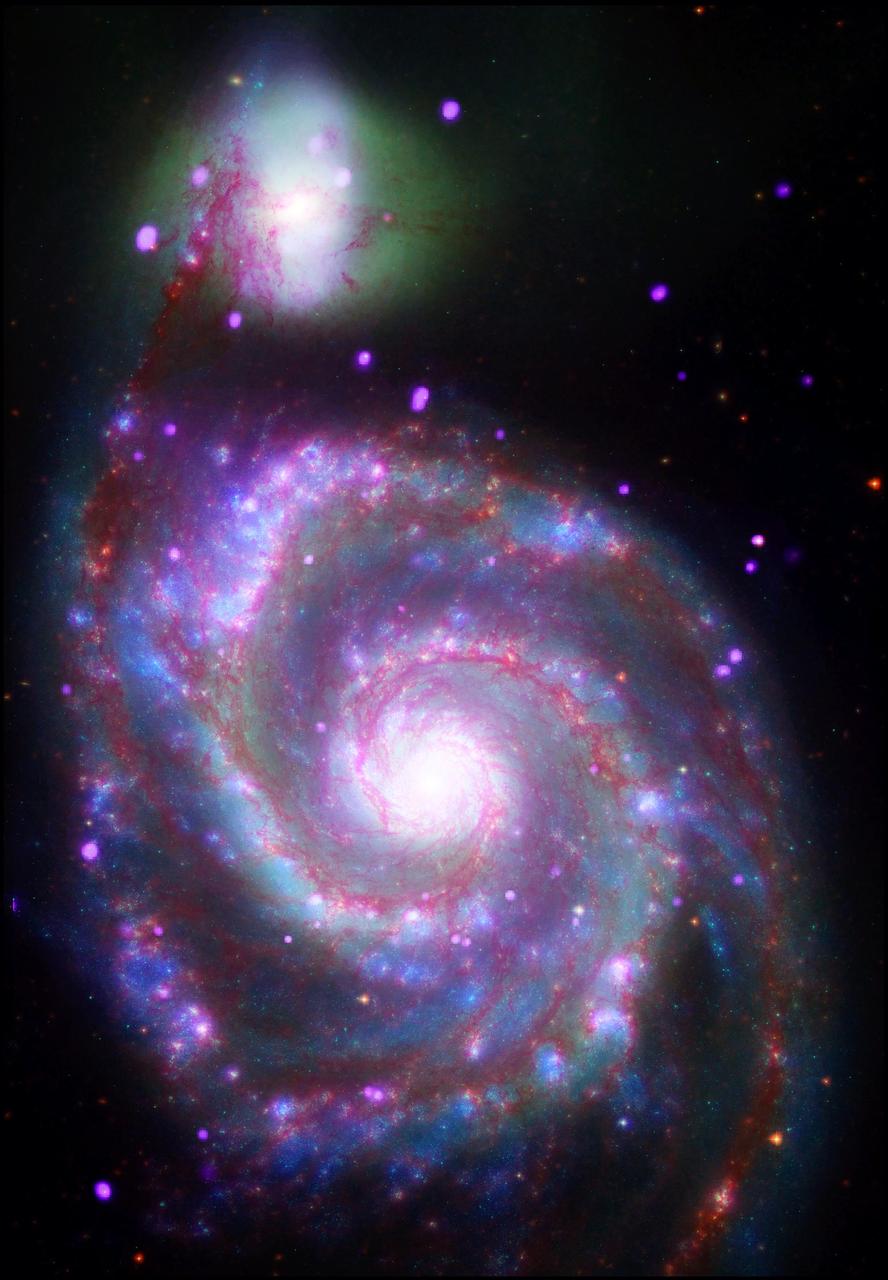
The first candidate in another galaxy
M51-ULS-1b was announced in 2020 by Di Stefano and colleagues. They found that a bright X-ray source in the Whirlpool Galaxy dimmed almost to nothing for about three hours, then recovered. The most natural explanation is a planet passing in front of the X-ray source and blocking its light.
If the interpretation holds, M51-ULS-1b would be the first planet ever detected outside the Milky Way, orbiting not a quiet star but a compact remnant in an X-ray binary.
What the measurements tell us
The transit implies a body with a most probable radius slightly smaller than Saturn's. Its mass is unmeasured, and because the host is an X-ray binary rather than an ordinary star, the usual techniques of the exoplanet field do not directly apply.
The orbit is unknown. If the planet orbits far from the binary, another transit may not happen for decades, which is why the object remains a candidate rather than a confirmed planet.
A hostile neighbourhood
A world around M51-ULS-1 would orbit close to a compact object pouring out X-rays and a massive, luminous companion star. Any such planet would have formed under, or survived, extreme conditions very different from those of the Solar System.
That is part of the appeal: X-ray transits open a window on a population of planets, and planetary survivors, that optical searches cannot see.
Open questions
- Is the dip really a planet, or some other dimming of the X-ray source?
- What is the planet's mass, and how far does it orbit from the binary?
- Could the planet have formed in place, or was it captured?
- How common are planets around X-ray binaries in other galaxies?
Worth knowing
M51-ULS-1b is the first candidate planet found in another galaxy.
It was detected by the shadow it cast in X-ray light.
It is roughly the size of Saturn, if confirmed.
Recent publications
| Year | Study | What it adds | Paper |
|---|---|---|---|
| 2020 | Di Stefano et al., arXiv:2009.08987 | Announces the first candidate planet in an external galaxy, found through an X-ray transit. | arXiv |
| 2021 | Di Stefano et al., Nature Astronomy | Peer-reviewed publication of the M51-ULS-1b candidate. | 10.1038/s41550-021-01495-w |
Values compiled from the discovery paper. The planet remains a candidate until a repeat transit is observed.